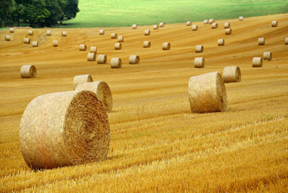
When lush spring pasture is baled, the job does not end when the bale leaves the chamber. High-moisture ryegrass and clover can create strong outward pressure as the bale settles and tries to expand. High-quality net wrap needs sufficient cross-directional tensile strength to withstand that pressure without tearing, opening at the edges, or causing the bale to lose its shape.
For Australian contractors and farmers working with dense spring pasture, selecting net wrap based on more than roll length is important. The right product should provide consistent coverage, strong resistance to bursting and reliable containment from the baler through transport and storage.
Why Lush Pasture Creates Expansion Pressure
Ryegrass and clover can produce dense, heavy bales when conditions suit baling. Their fine stems and leafy material can pack tightly inside the chamber, creating substantial internal pressure.
Once the bale exits the chamber, the compressed material naturally attempts to recover some of its original volume. This spring-back effect can place additional load on the net wrap, particularly when bales are made at high density.
Moisture also matters. Wet or high-moisture forage can be heavier and more difficult to manage if the bale loses its structural integrity. A net wrap that cannot contain the bale evenly may contribute to bulging, loose edges or distorted bale shoulders.
Cross-Directional Strength Matters
Net wrap must withstand forces both across its width and along the strands. Cross-directional tensile strength is particularly important when a dense bale pushes outward against the netting.
A high-quality net wrap burst strength rating or comparable manufacturer performance specification can help buyers assess how well a product is designed to resist sudden outward loading. However, burst resistance should be considered alongside tensile strength, stretch characteristics, edge-to-edge coverage and resistance to tearing.
Look for net wrap that provides:
● Strong cross-directional reinforcement
● Consistent tension across the full bale width
● Reliable edge coverage
● Resistance to tear propagation
● Stable performance during high-density baling
● Compatibility with the baler’s wrapping system
Matching Net Wrap to Australian Spring Conditions
Spring pasture conditions vary considerably across Australia. Dairy and livestock regions in Victoria, Tasmania and southern New South Wales can produce vigorous ryegrass and clover growth, while other areas may face different forage mixes and baling conditions.
The goal is not simply to use the strongest-looking product. High-quality net wrap should match forage density, bale dimensions, baler settings, and intended storage conditions.
Before purchasing, check the manufacturer’s technical information for tensile performance and recommended applications. Contractors should also consider whether the net feeds consistently at their baler’s operating speed.
Avoiding Bale Distortion
Bale shape provides a useful visual indication of containment performance. If a freshly wrapped bale develops pronounced shoulders, uneven edges or noticeable bulging, investigate the cause before continuing a large baling run.
Possible factors include:
● Excessive bale density
● Incorrect chamber or pressure settings
● Insufficient net application
● Poor net tension
● Uneven crop flow
● Net that lacks sufficient resistance to expansion
A properly selected product should work with correct baler settings rather than compensate for mechanical or operational problems.
Choosing Net Wrap for Dense Pasture
For high-density spring bales, buyers should assess the complete performance specification rather than focusing solely on price per roll. A longer roll can reduce changeovers, but it does not automatically provide better containment.
Agricultural netting solution should maintain coverage while the bale expands after leaving the chamber. Strong, consistent construction helps keep the forage contained and reduces the risk of net failure during handling.
Conclusion
Dense ryegrass and clover bales can place significant outward pressure on net wrap as compressed forage expands. Strong cross-directional performance, dependable burst resistance and consistent edge coverage are therefore important considerations for Australian spring baling.
Choose high-quality net wrap based on the forage, baler, bale density and handling requirements. Check technical specifications with your supplier and select a product designed for demanding high-density applications before your next spring baling run.
—
Frequently Asked Questions
1. Why does spring pasture cause bale expansion?
Dense ryegrass and clover can become highly compressed inside the baler. After ejection, the forage can push outward as it attempts to recover some of its compressed volume.
2. What is important about cross-directional tensile strength?
It indicates how well the net can resist forces acting across its width. This matters when dense forage puts outward pressure on the wrapped bale.
3. What does high-quality net wrap burst strength indicate?
It relates to the net’s ability to resist failure under outward loading. It should be considered alongside tensile strength, tear resistance and overall construction.
4. Can net wrap prevent bale distortion?
Suitable net wrap can help maintain containment, but correct baler settings, crop flow, bale density and application are also essential for producing consistent bales.
5. What should Australian farmers consider when choosing net wrap?
Consider forage type, bale density, baler compatibility, coverage, tensile performance, tear resistance, storage conditions and the manufacturer’s technical specifications.